


As businesses grow, they often expand — new concepts, locations, product lines, or campaigns emerge. The question then becomes: Should you keep everything under your main website, or give your new venture its own digital home?
Many brands default to subdomains or nested URLs:
- newconcept.yourbrand.com
- yourbrand.com/territory/campaign/newidea
It’s familiar, convenient, and easy to set up–But sometimes, that choice hides your next big idea under layers of digital furniture.
Let’s unpack when it’s smarter — and more powerful — to
launch a new domain (especially on memorable extensions like .BAR or .REST) instead of relying on subdomains.
When your new concept deserves its own identity
If your new project has its own name, audience, and vibe, it deserves to stand on its own. A subdomain still ties it tightly to your parent brand — which can limit creative freedom and confuse customers about what’s what.
Example:
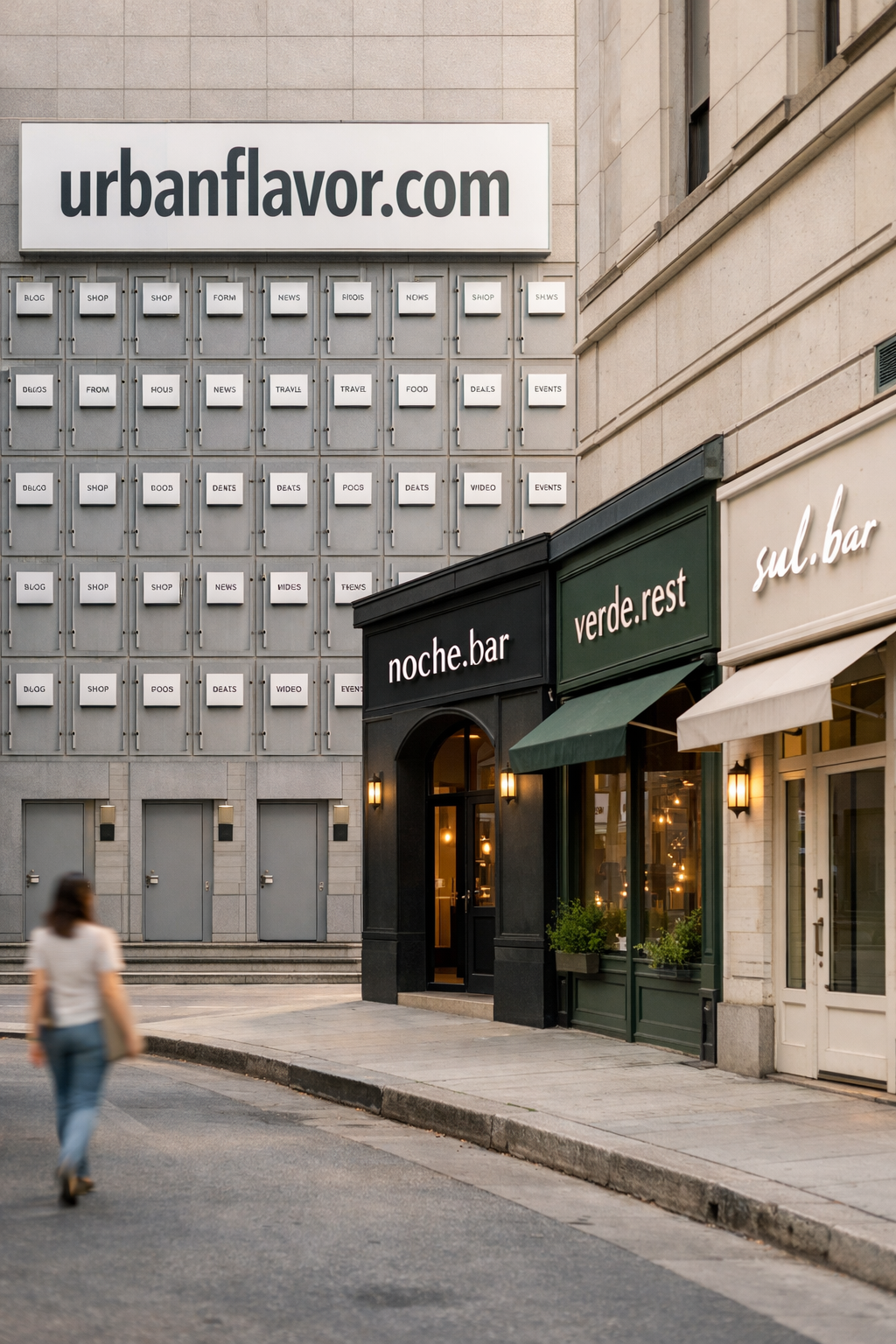
A restaurant group with a main domain urbanflavor.com launches a bar concept called Noche.
Instead of
noche.urbanflavor.com, imagine: noche.bar
Instantly independent, elegant, and easy to share. It feels like a brand — not a subsection.

When clarity and memorability matter
Every extra slash or dot makes people forget faster. A short, clean domain like noche.bar or fusion.rest sticks in memory, looks better on menus and signage, and is easier to type, say, and share.
→
Subdomains often look like internal pages, not real destinations.
Consumers scan and click based on trust and clarity — and a strong, dedicated domain says“this is a real place, not a side project.”
When you’re targeting a different audience or geography

If your new project serves a different region, demographic, or even business model, separating it with a new domain keeps your messaging focused.
→
Subdomains can create SEO or navigation confusion — especially when multiple teams handle different verticals.
Example:
A hospitality group with their main site as
coastalgroup.com
launches:
- A wine bar in Lisbon – sul.bar
- A vegan restaurant concept – verde.rest
Each has its own story, tone, and local presence — all tied together by brand family, but distinct online.
When you want creative freedom (and marketing flexibility)
Separate domains give teams freedom to experiment with visuals, voice, and digital strategy — without affecting the parent site’s structure or SEO.
Campaigns, collaborations, or pop-ups benefit from that agility: you can launch, test, and sunset domains as needed.
→
A subdomain or deep URL is harder to detach, measure, or reposition.
When you’re building a portfolio, not just a website
Large hospitality or lifestyle groups increasingly use domain strategy as part of brand architecture — each concept under the umbrella has its own strong identity, but all feel connected through consistent quality or design.
Think of it like real estate: Your headquarters and your new venue don’t share the same address — but both belong to the same company.
Domain = digital address.
And great addresses, like short and sweet .BAR and .REST names, are limited assets that grow in value over time.
TL;DR* – Subdomains keep things under you. New domains let them stand beside you.
| Situation | Use Subdomain | Use New Domain |
|---|---|---|
| Internal tools, staff portals | ✅ | ❌ |
| New brand, concept, or location | ❌ | ✅ |
| Short-term campaign microsite | ❌ | ✅ |
| SEO experiment or content hub | ✅ | ✅ (if branding is key) |
| Independent customer-facing brand | ❌ | ✅ |
*TL;DR = “Too Long; Didn’t Read” - used in internet slang to define things that are overlong to read.
In the hospitality world, groups like Flagship Restaurant Group operate multiple distinct restaurant & bar brands under one umbrella — each with independent brand identities. Also, local examples like Dogwood Domain (Austin) show that venue / bar brands often behave as standalone experiences, which is the same mental model that domain separation supports.
As more brands embrace new TLDs, these early signals suggest we’ll see growing examples of groups launching ConceptName.bar or ConceptName.rest as full-fledged brand homes rather than sub-folders of a parent site.
Final thought
If your next venture has its own flavor, voice, and audience — give it a name that breathes on its own.
A subdomain says “this belongs to something else.”
A new domain says “this is something.”
And with smart, global extensions like .BAR and .REST, you’re not just naming a site — you’re shaping a brand.
Latest posts